
Unless you’ve been living on a remote island for the last twenty-or-so years, you will have heard of digital marketing.
Before the internet became available globally and easily accessible through new devices like smartphones, advertising and marketing were done the “traditional” way using TV and radio ads, placing ads in magazines and newspapers, and by putting up giant billboards and signs for everyone to see.
Now, the way in which people consume advertisements has completely changed due to the dominance of the digital world.
Although a small amount of people still listens to the radio, watch TV, and read newspapers, these media platforms have been relegated to the back seat of effective advertising options.
These options are no longer mainstream, meaning they do not reach any reasonably-sized audience.
INDEX
- What’s mainstream?
- Main channels involved in digital marketing
- Social media
- Search engines
- Content
- Web design
- Language
What’s mainstream?
The Internet.
Social media, websites, search engines, SEO, podcasts, and pretty much everything and anything that involves the digital world has become today’s mainstream marketing arena. Marketing on the internet has been so transformative and innovative that it has even been given its own name: digital marketing.
Technically, digital marketing involves any form of marketing done through an electronic device rather than being internet-based, so it does include radio and television. Radio and TV simply don’t contribute much to the equation because they have been replaced by online alternatives. Because of this, colloquially speaking, digital marketing refers to marketing done through the Internet.
Every day more and more business owners move their marketing and advertising campaigns from the physical to the digital world. Instead of spending thousands on a billboard, many are spending thousands on a banner on a website that gets millions of visitors a month.
And regardless of a business’ size, business owners understand that to reach their audience and their target market, they need to be visible where their audience can actually see them. Maximized visibility doesn’t come from being on a poster at the bus stop because everyone there will be looking at their phones. The same goes when someone is waiting in a doctor’s office; they’re not flipping through the pages of a magazine, they’re on their phone browsing through social media, search engines, or websites.
The digital world brings more people together than any other communication platform or form of media in history, making digital marketing the most relevant form of marketing for any business.
Main channels involved in digital marketing
Social Media
Social Media
Social media platforms have become some the most successful channels for digital marketing. There is already a long list of people who have become millionaires by effectively using social media marketing, and although they didn’t become billionaires like the creators of the platforms, they easily hit the millionaire mark. Social media influencers in particular who can gather millions of followers can get paid a pretty penny just for mentioning a brand. This is one example of how advertising on social media works, and it’s an effective method for creating brand awareness.
On another note, platform creators like Mark Zuckerberg have made their fortunes by providing paid ads on their social media platforms, such as advertising campaigns on Facebook and Instagram.
So… which social media platforms are out there?
There are several well-known platforms like Facebook, Instagram, Twitter, and LinkedIn, but just like fashion trends, there are always new social media platforms becoming trendy while others fall out of fashion, like in the case of Snapchat and Vine.
The most popular social media platforms are:
Yes! Facebook is still the king when it comes to social media. According to Statista, Facebook has 2.7 billion active monthly users on its platform. That’s over 1/3 of the world’s population hanging out in ONE place!
Admittedly, Facebook doesn’t appeal to younger generations as much as it once did when it first came out back in 2006/2007, but that doesn’t mean younger generations have logged out completely because they’re really hanging out on other social media platforms as well as on Facebook.
Instagram has become one of the leading social media platforms with 855 million users according to Statista. As we can see, it has less than half the users that Facebook has, but this number is expected to keep increasing. It is estimated that by the year 2023, Instagram will surpass 1 billion users.
Instagram is known for drawing in a younger crowd than Facebook is able to, and it’s important to take age and generational demographics into account for each platform. Facebook came out when millennials were youngsters, teenagers, and young adults. Now millennials are in their mid-twenties and many are hitting 40. Many of them have abstained from adapting to new social media trends such as Instagram, opting to remain with Facebook.
In the same way, Instagram is a magnet for a younger crowd such as late millennials and generation Z, which have grown up with technology in their hands.
As generation Z continues to get older, they’re increasingly drawn to Instagram rather than Facebook. This is one of the reasons why the number of users will only continue to grow. It’s important to understand that many people in generation Z are children right now, but as they get older, they’ll want to join the social media wagon, which means an exponential growth in the number of users of several more modern social media platforms such as Instagram. Chances are that this new generation won’t be creating Facebook accounts since Facebook is viewed as being for older users, and so they will be exploring other social media markets.
For now, Facebook is king, and Instagram is the firstborn heir to the throne who will someday become king when its father becomes obsolete.
Note: For the writing of this article, we’re using the Pew Research Center’s generational definition to determine the ages of each generation. Millennials in this instance are catalogued as being born between 1981 and 1996, while Generation Z refers to those born between 1996 and 2012.
Twitter is probably one of the social media platforms that baffles digital marketers the most.
It’s not really the money maker that Facebook is, or as visually appealing as Instagram. Twitter draws in its own crowd and tends to revolve more around intellectual/formal social environments (we’re generalizing here; we know Donald Trump is an active Twitter user).
With only 330 million users and characteristically only allowing short messages, Twitter requires a savvier digital marketing strategy to position a brand within its platform. Not many brands have the budget to hire an experienced and highly effective person to create more personalized and engaging content for Twitter, since it’s generally more expensive if you want to create content that matters.
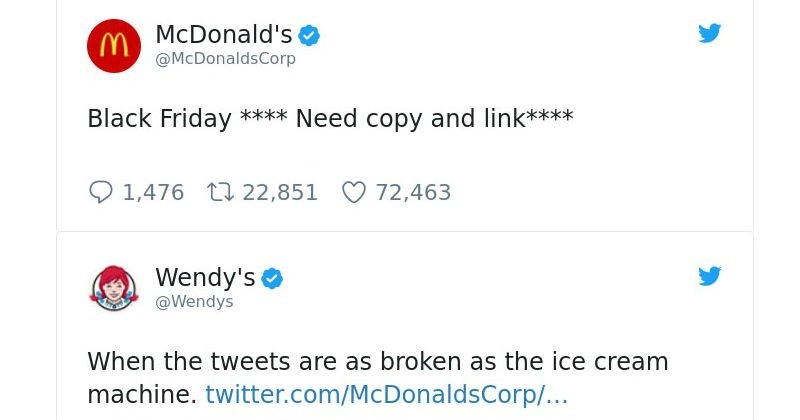
Wendy’s is an example of a big company that killed it on Twitter. With their funny, witty, and savage posts, even if you’re a vegetarian you will still want to follow them on Twitter for entertainment.
Also, with only 330 million users, many small companies prefer to spend their money on platforms that have a bigger audience.
Tik Tok
Unless you’ve been living your entire life offline, then you would’ve seen how Tik Tok has quickly sky-rocketed to the social media stratosphere with a growth rate of 800% since early 2018. It currently has 100 million users, and that number just keeps growing.
However, although it has a surprisingly high growth rate, whether Tik Tok will survive long term is another matter. History has shown us that many new social media platforms are like boy-bands; They pop up to create a frenzy and then die out, just like with Snapchat and Vine.
These platforms offered a limited service that users got bored of. Yeah, the Snapchat filters were fun, but after a while it gets old. And the 30-second videos in Vine became shallow and boring after a while, which led to its imminent death.
Will the same happen to Tik Tok?
Additionally, many governments have been looking at restricting Tik Tok out of fears for the safety of data and network security of users and nations alike, meaning that Tik Tok may have more to overcome than other platforms.
It’s still too early to find out, but if you’re a small brand with a limited digital marketing budget then we would suggest spending it somewhere else for the time being.
YouTube
YouTube is the king of video.
Many people have canceled their cable subscription because YouTube provides a nearly endless amount of content to sit back and relax to.
With 2 billion active users, YouTube has positioned itself as a global go-to channel for video content.
YouTube has bought a lot of people global fame and turned many brands into worldwide, household names.
The magic of YouTube not only rests in its video-only platform, but also in its generational-friendly content. Whether you’re 80-years-old or a newborn, chances are that you’ve seen YouTube content or eventually will in your life.
YouTube is designed for all ages and you don’t even need an account to scroll around.
There are many other social media platforms that we won’t be discussing in this article such as Reddit, Quora, and many others which we will discuss in-depth in another article.
Search Engines
Search engines are pivotal for driving people to your website. There’s a reason why SEO (search engine optimization) has become crucially important in this day and age.
When someone is looking for something, they go to search engines. People mainly choose Google, while Bing and Yahoo are like the lower quality options that people forget about and normally don’t choose first.
Whether you’re looking for an address, a business, a service, or a product, Google is the go-to search engine that can fix almost any problem and give you the right information. This makes Google to number 1 destination for digital advertising as it can put you site in direct contact with an almost unlimited number of people when things are setup correctly
There are two ways to get your website to appear on the first page of Google with your desired keywords;
1. Google ads
Google ads is a monster of its own. If you think that you can just pay a few bucks and voila! your ad will be the first to show up, then think again.
Google ads are what is known as PPC in digital marketing slang, where PPC stands for Pay Per Click. If you have no idea of what you’re doing when you pay for ads on Google then stay away from this option, because you’ll end up flushing your money down the toilet.
PPC requires a lot of specialized knowledge to maximize your investment. There’s keyword competition, keyword auction, a keyword strategy and the continual monitoring of campaigns so you end up with a $100 thousand-dollar bill and no clicks.
Pros of PPC or Google Ad campaigns
If you need to see results pronto, this is the go-to mechanism to quickly drive clicks and traffic to your site.
It’s a fast way to get your site on the first page of Google
Cons of PPC and Google Ads
First of all, people can get discouraged when they see the label “ad” on the link.
Google has become the judge of “quality” when it comes to products and services, so if you’re on the first page of Google then people will think you’re a hot-shot in your area, also, no one clicks beyond the first page of Google, well… maybe they’ll click on the second page.
When they see the label “ad”, they know you didn’t get there by being awesome. You got there because you bought your way on to the first page via a paid ad.
This can discourage a lot of people from clicking on your ad or taking your business as an authority.
2. SEO Search Engine Optimization
SEO is a way of organically placing your site on the search engines.
SEO is composed of several areas:
Keyword Research and Strategy
A keyword strategy is fundamental to position your website on search engines. You need to tell Google what you want to be known for.
In a keyword strategy, your business is analyzed to determine which are the best keywords to rank for, as well as which will serve your budget the best.
Let’s look at an example:
You sell insurance and you want to rank for the word “insurance”.
“Insurance” is a very generic keyword. If someone is just Googling “insurance” then it’s because they’re probably looking for the etymology of the word, the history of insurance, or something wider about the term rather than a specific service.
“Insurance” is an extremely desired keyword as well, which means that you’ll be competing against macro corporations for that keyword and because of that, chances are you won’t make it onto the first page of Google unless you have some seriously deep pockets.
A better strategy is to focus your keyword strategy on more specific words or phrases like: “health insurance for low income families”. You won’t get as much traffic as you would for ranking with the word “insurance” but you would also not be spending as much and the traffic that you do get will most likely be the traffic that you’re looking for such as people who are looking for health insurance on a budget.
You can work with your SEO team to create the perfect keyword strategy for your business. This is the base of any and all SEO strategies for your business.
Technical (onsite) SEO optimization
Onsite SEO optimization is the art of optimizing all the technical aspects, content, and images on your site.
This includes:
- Title
- Meta-title
- Alt tag images
- Headlines
- Download speed
- H1 and H2
- Content
And so on.
Everything needs to be aligned with your keyword strategy and optimized to tell Google what you’re all about.
Google algorithms are like the high-school mean girls that need to know who you are to know if it’s worth it to hang out with you or not.
Offsite SEO Optimization
Here is where we want to hang out with other cool people so that Google’s algorithms like us by association.
In this area a site needs to focus on the following:
– Creating shareable content
– Working with social media influencers and other well-known sites
– Guest blogging to create valuable links.
Which takes us to our next point
Link Building
A lot of people don’t understand the value of link building.
Link building is about getting your link on another website who then links back to yours. It’s not as simple as it sounds since there are a lot of aspects that need to be taken into consideration.
Link building is literally increasing your rank by association. Think of a popularity contest where someone says “tell me who you hang out with and I’ll see if you’re awesome or not”.
Getting your link on an authoritative site can help your site a lot, not only by driving traffic in but also by improving the SEO juice. For a link to be of good quality it needs:
– To have a high rank. This means a high DA, traffic, and other indicators.
– To be reputable. You don’t want to have your link on a site that promotes porn or gambling. This is a big “no-no” for Google algorithms.
– To have your keyword in place.
– To have traffic.
– Be do-follow.
We will discuss this further in another article.
Backlink Management
Just as in the real world, you can have SEO shade thrown at your business. This means that someone who doesn’t like you has sent some shady links your way, which can negatively affect your site on search engines.
Backlink management refers to how your backlink profile (all the links pointed to your site) are analyzed, and we can tell Google which nasty sites we don’t want to be associated with.
Web Design
Your website needs to be built in an SEO friendly manner. If it was not originally done this way then no worries, it can be fixed.
There is mainstream web design, and then there’s SEO web design/redesign which is where the entire website is analyzed to check how it can be optimized. From code to images and everything in between. Generally, all sites need some sort of web redesign to be SEO-friendly.
This doesn’t mean that the aesthetics of your website changes. The changes happen backstage in the code and/or technical details to align all of it to your keyword strategy.
Here is where we’re talking about updates, XML files, HTML requests, and other aspects that affect your SEO.
Content
Content is not just what you’re saying to your audience, it’s also what you’re saying to search engines.
There’s content and then there’s SEO content.
When it comes to your web copy and your blog posts, every word on your website needs to also be aligned with your keyword strategy. You need to make Google algorithms understand who you are and the quality of your business.
Web Design
Just as people want their physical business to be beautiful, your website needs to be beautiful and functional as well, especially in today’s times.
If COVID left anything behind besides a dreadful recession, it also pressured businesses into transferring to the digital world.
Because people now generally spend more time in the digital world than in the physical world, businesses need to have a functioning website regardless of their size. They need to solidify their digital presence not just with social media profiles but with a functional and aesthetically pleasing website as well.
Language
It’s no secret that our world is becoming more globalized each passing day. Your target marketing is no longer within your city; it could also be in other countries. Don’t limit your audience or your target market because of a language barrier.
You can make a purchase today in China and have it delivered within a few days to your doorstep. If you have an online magazine or blog, your visitors can also be on the other side of the world from where you are.
Expanding your audience is a lot easier today thanks to the internet, and all you need is to break the language barrier by offering a bilingual website which appeals to your two most desired target markets.
When someone has the opportunity to use their native language when interacting with your company, they will develop a stronger bond with you. It communicates to them that you acknowledge them and their language and that they’re welcome in your business.
As we have seen, there are several areas to work on when it comes to digital marketing. It might seem overwhelming for small companies working on a tight budget. Nevertheless, don’t feel discourage, you don’t have to develop of all these areas straight away.
An ethical digital marketing agency will work with you, your budget and your goals to guide you on the right path and get the highest ROI according to your budget.
Everything is possible when you work with the right people.